


Airbnb’s November 20, 2026 Policy Changes: What Hosts Can No Longer Require - and Who Is Exempt

If you manage an Airbnb property,November 20 could change more than your checkout instructions. It could change how you protect your property, establish guest expectations, collect guest information, and enforce the terms of a reservation.
The following is a practical guide to Airbnb's upcoming policy changes and what they mean for short-term rental owners.
Airbnb is introducing sweeping changes to its house rules and host-imposed requirements, including significant restrictions on separate rental agreements, guest identification requests, checkout chores, and host-imposed penalties. For many hosts, practices that have long been part of their standard operating procedures will no longer be permitted for qualifying reservations.
But there's an important distinction that has been lost in much of the discussion: Not every host is subject to the same restrictions.
Airbnb recognizes specific exceptions for properties with legal or insurance requirements, certain homeowners association rules, monthly stays of 28 nights or longer, Airbnb Luxe listings, and agreements associated with optional amenities. Those exceptions matter, and understanding where your property falls is essential before making changes to your management procedures.
For hosts who don't qualify for an exemption, the question becomes equally important: What must you give up, what can you still require of your guests, and how do you maintain reasonable protections for your property without violating Airbnb's new policies?
Let's break down exactly what's changing, who is exempt, and what every Airbnb host needs to know before November 20, 2026.
What's Changing on Airbnb November 20, 2026?
The new policies affect how hosts establish guest requirements, enforce house rules, and manage reservations. Here are the major changes:
Rental agreements: Separate agreements generally cannot be required unless the reservation qualifies for a specific exemption.
Guest information: Restrictions apply to requiring identification, contact information, and other personal details outside Airbnb's platform.
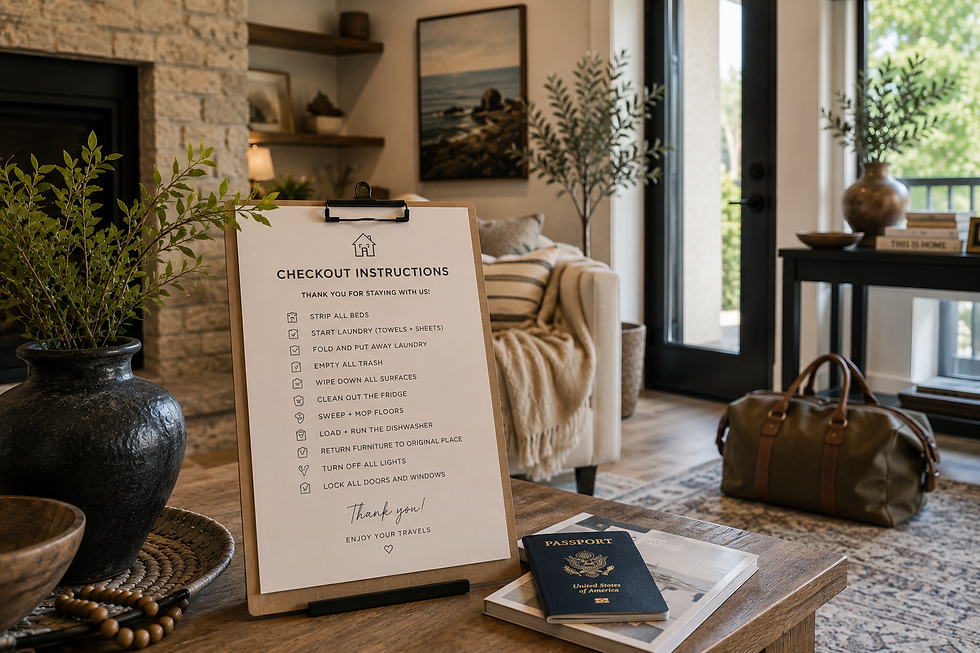
Checkout chores: Hosts cannot require extensive cleaning tasks such as stripping beds, doing laundry, or washing and putting away dishes.
Fines and penalties: Hosts cannot impose their own financial penalties for house rule violations. Damage claims and excessive cleaning claims must follow Airbnb's reimbursement process.
House rules: Airbnb is standardizing seven categories of house rules, while still allowing reasonable property-specific requests.
Third-party registration: Hosts generally cannot require guests to use outside websites or download apps as a condition of their stay, subject to limited exceptions.
Amenities and additional fees: Hosts cannot advertise an amenity as included and then charge guests extra to access it. For example, a property advertised with a heated pool should include pool heating in its advertised price. Hosts may offer optional pool heating as a separately disclosed add-on when the pool itself is advertised without heating.
Who Is Exempt From the Rental Agreement Restrictions?
Airbnb recognizes specific exceptions allowing separate agreements in certain circumstances:
Legal requirements: Agreements required by state or local law, including applicable STR ordinances.
HOA requirements: Agreements mandated by documented homeowners association rules.
Insurance requirements: Agreements specifically required by the property's insurance provider.
Monthly stays: Reservations of 28 nights or longer.
Airbnb Luxe: Listings qualifying under Airbnb's Luxe program.
Important: These exemptions apply to qualifying rental agreements, not blanket exemptions from Airbnb's other policies. Hosts must still follow applicable platform rules, and permitted agreements must be disclosed and uploaded as required by Airbnb.
Who Is Not Exempt?
If you operate a conventional short-term rental and require a separate agreement simply as part of your standard business practice, you will generally fall under the new restrictions.
That means:
You cannot require a separate rental agreement simply because you prefer one.
You cannot require a blanket liability waiver as a condition of booking without a qualifying exception.
You cannot move prohibited requirements into automated messages, third-party portals, or pre-arrival forms to get around Airbnb's rules.
For these hosts, the focus now shifts to what Airbnb still allows you to require, how to establish reasonable house rules, and how to protect your property without relying on a mandatory separate rental agreement.
At Dream Stay Vacation Rentals, we recognize that no two properties - or their legal and operational requirements - are exactly alike. For each client, we evaluate the property's location, applicable regional ordinances, the necessity of a separate rental agreement, and the protections currently in place before determining the best course of action.
In some cases, that may mean modifying existing procedures. In others, we may recommend that the owner review their supplemental short-term rental insurance policy, particularly its provisions regarding guest liability, property damage, contractual requirements, and coverage conditions.
Our approach is not to apply a one-size-fits-all solution, but to identify the best path forward for each property while keeping the owner's interests protected and maintaining compliance with Airbnb's updated policies.
What Checkout Requests Are Still Allowed?
The new policy does not mean guests can simply walk out and leave everything for the cleaning crew. Hosts can still establish reasonable expectations for leaving the property in an orderly condition.
Airbnb specifically identifies these requests as acceptable:
A note about dishes: Hosts may ask guests to place used dishes in the sink before checkout. While food residue and dirty dishes can create sanitation and pest-control concerns, Airbnb's updated policy does not specifically authorize requiring guests to rinse dishes or load the dishwasher. Hosts should plan their turnover procedures accordingly until this gray area becomes clear.
Towels: Ask guests to gather used towels in one designated location.
Trash and recycling: Ask guests to separate waste and recycling into the designated indoor bins.
Utilities: Ask guests to turn off air conditioning, lights, and other utilities when leaving.
Property security: Guests can be asked to lock doors and secure the property at checkout.

What About Remote, Mountain and Rural Properties?
Not every property has municipal curbside trash collection. Some communities require residents and visitors to transport waste to designated collection facilities, while others have wildlife-protection requirements governing how garbage must be secured.
Airbnb says it considers local laws and property-specific circumstances when evaluating whether an additional rule is reasonable. It even recognizes that requiring guests to use an animal-proof trash container in bear country may be justified.
For hosts operating in these areas, the important consideration is whether the disposal requirement is supported by an actual local ordinance, municipal requirement, HOA regulation, or legitimate property-specific safety concern.
Our recommendation: Don't automatically remove a legitimate, location-specific requirement simply because Airbnb's general policy discourages off-site trash removal.
Clearly disclose the requirement in your listing's designated house rules section and retain documentation supporting it, such as the applicable municipal ordinance or waste-disposal regulations.
If Airbnb subsequently flags the requirement, you'll have the opportunity to explain the circumstances and provide supporting documentation through its review and appeal process.
Can Airbnb Hosts Still Require Government ID?

Yes. But there is an important distinction between physically checking a guest's identification and collecting or retaining a copy.
In-person ID verification: Airbnb allows hosts to physically inspect a guest's government-issued ID at check-in to verify identity, provided the requirement is disclosed in the listing's Additional Rules section before booking. Hosts may visually compare the ID with the person checking in, but cannot retain a physical or digital copy under this provision.
Collecting or retaining ID information: This is more restrictive. Airbnb permits collecting personal information when necessary to comply with applicable laws, documented HOA or community association rules, or to facilitate an otherwise permitted rental agreement.
For example, a municipality may require short-term rental operators to register guests and collect specific identifying information. A condominium association may also require guest registration for building security.
Simply wanting a copy of a guest's driver's license for security or liability protection does not establish an exemption.
Before continuing an ID collection process, owners should:
Review applicable city and county STR ordinances.
Check HOA or community association requirements.
Determine precisely what information the regulation requires.
Disclose what guests must provide and why in Airbnb's Additional Rules section before booking.
Collect only the information necessary to satisfy the requirement.
Airbnb may request documentation supporting the exception, and hosts remain responsible for securely handling and disposing of sensitive guest information in accordance with applicable privacy laws.
What About Insurance Requirements?
This is another area worth investigating before abandoning existing guest verification procedures.
Some short-term rental insurance policies include specific underwriting conditions, documentation requirements, or guest-screening procedures. However, there is a distinction between an insurance carrier recommending identity verification and making it a condition of coverage.
Airbnb specifically recognizes insurance-provider requirements as grounds for allowing a separate rental agreement. However, that exception does not automatically extend to collecting and retaining copies of government identification.
If your carrier requires guest identification, ask your insurance agent:
Is government-issued identification actually required as a condition of coverage?
Must the ID be physically inspected, or must a copy be obtained?
Does the policy require retaining that information?
Does the carrier require a signed rental agreement or other guest acknowledgment?
Can the carrier provide the specific requirements in writing?
Our recommendation:
Have your insurance agent identify the actual policy provisions supporting your current procedures. If a separate rental agreement is required, that may qualify for Airbnb's insurance exception. If the carrier also requires collecting or retaining ID information, obtain clarification from Airbnb about whether that particular collection is permitted under its personal-information rules.
Don't assume a general insurance recommendation automatically creates an exemption.
What About Third-Party Apps and Guest Registration?
Many property managers use third-party applications for guest registration, digital guidebooks, access instructions, and automated check-in procedures.
Airbnb's updated policy generally prohibits requiring guests to register on an outside website or download an application to gain entry to the property or access an essential amenity like wifi, unless a qualifying exception applies.
There are some allowances:
Keyless entry applications may be offered, but hosts must provide an alternative access method if requested.
Optional applications that enhance the guest experience may still be offered.
Registration required by applicable law or documented community association rules may qualify for an exception.
Registration necessary to facilitate an otherwise permitted rental agreement may also qualify.
Property owners and managers should review their existing guest-management workflows to ensure that mandatory registration and personal-information collection are properly supported and disclosed.
Can Hosts Still Enforce Their House Rules?
Absolutely. Airbnb has not eliminated a host's ability to establish reasonable expectations or protect their property.
Guests are still expected to follow the house rules disclosed in the listing.
Airbnb confirms that hosts may cancel a reservation without penalties if a guest violates a house rule during their stay or indicates before check-in that they intend to violate one.
Hosts may also contact Airbnb for assistance when a guest violates property rules.
There is, however, an important distinction between enforcing a house rule and imposing a financial penalty.
Hosts generally cannot establish their own fines for rule violations. If a guest damages property, removes belongings, or causes excessive cleaning expenses, hosts may still pursue reimbursement through Airbnb's applicable claims process.
Hosts can also disclose fines that may be imposed by a local government or homeowners association, provided those potential fines are properly identified in the designated house rules section.
Where Should Your House Rules Be Listed?
One of the most important operational changes is where Airbnb expects hosts to disclose their requirements.
Airbnb is consolidating house rules into one designated area of the listing, making them more visible to prospective guests before they book.
The seven standard house rule categories are:
Maximum overnight guests
Pets
Smoking
Quiet hours
Events
Commercial photography and filming
Locking up at checkout
Additional property-specific rules and reasonable checkout instructions can be entered under Additional Rules.
This is important: Hosts cannot introduce new mandatory requirements after a reservation has been made through automated messages, digital guidebooks, signs inside the property, or personal communication.
You can certainly remind guests of rules they have already agreed to, but the original requirements must be disclosed in the designated listing section at the time of booking.
I recommend reviewing your listing descriptions, automated messages, digital guidebooks, and pre-arrival instructions to make sure everything is consistent.
What Happens When Airbnb Reviews Your Listing?
Airbnb's initial review period begins November 20, 2026, and continues through March 2027. Reviews will continue on an ongoing basis afterward.
If Airbnb identifies a rule that may not comply with its updated policy:
You'll receive notification through email and the Airbnb app.
Airbnb will identify the rule requiring attention.
You'll have at least 20 days to revise the rule or submit an appeal explaining why it is necessary for your property.
Supporting documentation, such as a local ordinance or HOA regulation, can be submitted with your appeal.
If a rule remains unapproved and unchanged, Airbnb may display a notice on your listing, reduce its visibility in search results, or take other enforcement action.
This is another reason to review your existing requirements now rather than wait until Airbnb flags something.
What About Hosts Using Property Management Software (PMS)?
There may be some additional flexibility for hosts managing Airbnb listings through API-connected property management software.
According to an October 28 communication from OwnerRez, Airbnb has verbally indicated that API-connected hosts may have until March 1, 2027, to comply with the new requirements. However, Airbnb has not yet provided written confirmation, and the exact eligibility and scope of the extension remain unclear.
For now, PMS-connected hosts should not assume they are automatically exempt from the November 20 deadline. Continue preparing for the original date while watching for official clarification from Airbnb and your software provider.
The Bottom Line: Every Property Needs a Different Strategy
Airbnb's November 20 policy changes will require many hosts to rethink how they manage guest expectations, property protections, and pre-arrival procedures.
But this isn't a situation where every property needs to abandon its existing practices and start over.
Some hosts will qualify for specific exemptions. Others will need to modify their rental agreements, guest registration procedures, or checkout instructions. And some property-specific requirements may be entirely reasonable when supported by local regulations or legitimate operational circumstances.
At Dream Stay Vacation Rentals, we believe the best approach is to evaluate each property individually, understand the applicable requirements, and develop a management strategy that protects the owner's interests while remaining compliant with Airbnb's policies.
The goal is to understand which protections you can retain, which practices need to change, and how to adapt without compromising the quality of the guest experience.
Is Your Airbnb Property Ready for November 20?
Dream Stay Vacation Rentals can review your property's requirements, identify potential exemptions, and develop a strategy that protects your investment while keeping you compliant and ready to provide exclusion evidence to Airbnb.

Affiliate Disclosure: Certain links within this article are affiliate links. Dream Stay Vacation Rentals may receive compensation when readers make a purchase through these links. Prices may vary, and eligible promotional offers or discount codes may provide readers with savings.


Comments